27
January
2026
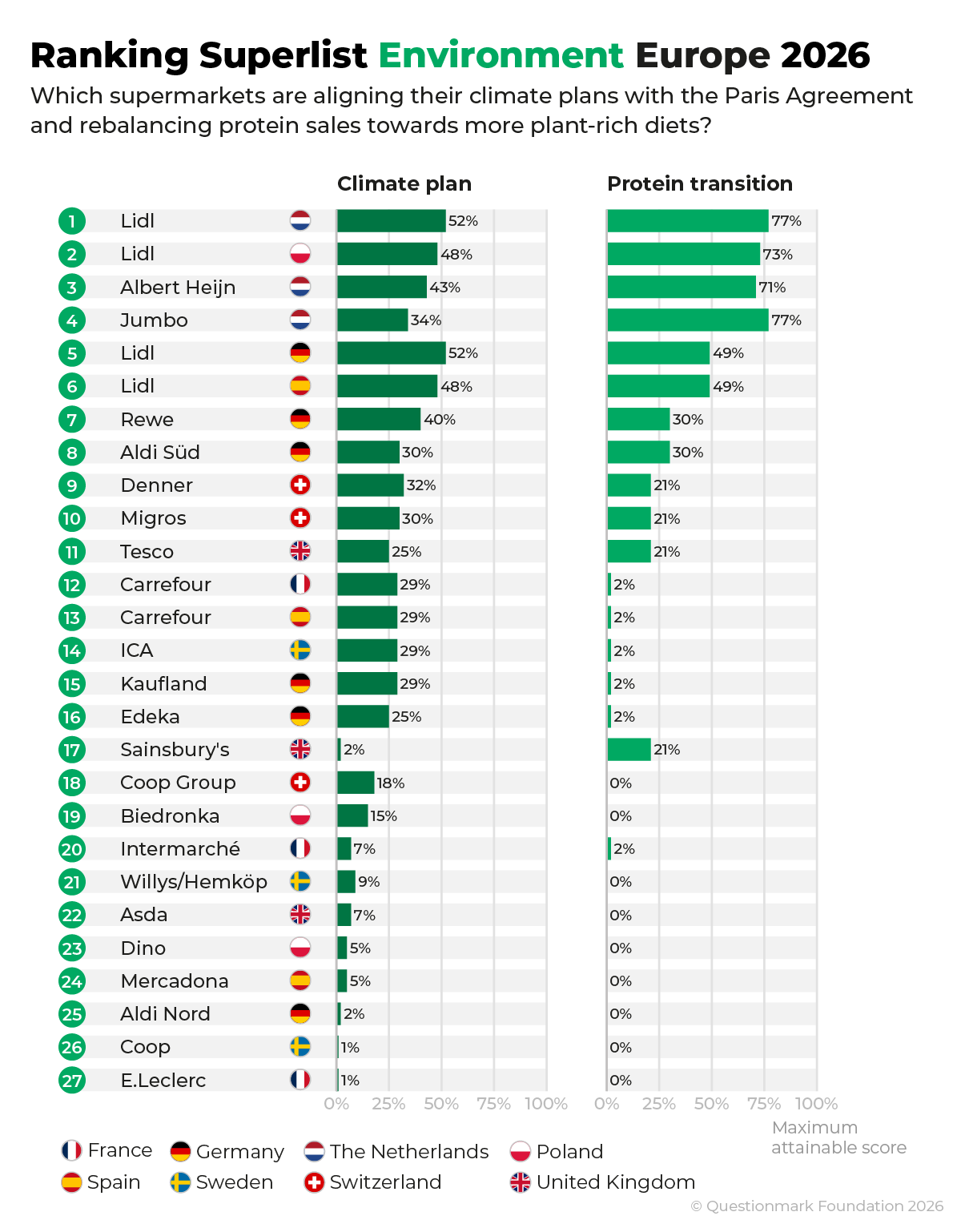
The first European benchmark looking at the climate performance of 27 supermarkets across eight countries has revealed Dutch and German retailers leading the way.
The Superlist Environment Europe, released today, assesses how aligned supermarkets' climate plans are with the Paris Agreement and their efforts to shift protein sales to sell more plants.
Among its main findings are:
- Seven supermarkets have published detailed roadmaps to reduce emissions.
- Two-thirds of supermarkets recognise their role in shifting to more plant-rich diets that benefit the planet and people's health.
- Dutch and German retailers dominate the higher rankings with discounter Lidl leading.
The Superlist looked at the top three supermarkets by market share in France, Germany, the Netherlands, Poland, Spain, Sweden, Switzerland and the UK.
Leaders such as Dutch retailers Albert Heijn and Jumbo, Lidl (in four countries) and REWE and Aldi Süd in Germany show the strongest commitment to cutting emissions, especially by rebalancing protein sales - a crucial step in hitting climate targets while also providing customers with healthy, affordable food.
The lower-ranked supermarkets showed less ambition in their climate plans and make little to no effort to rebalance their protein sales to include more plants and fewer animals.
Signs on emissions not encouraging
While five supermarkets had reduced overall emissions since they started reporting them, the majority have not, and inconsistent reporting makes it difficult to assess progress. This highlights the need for standardised reporting aligned with the historic Paris Agreement.
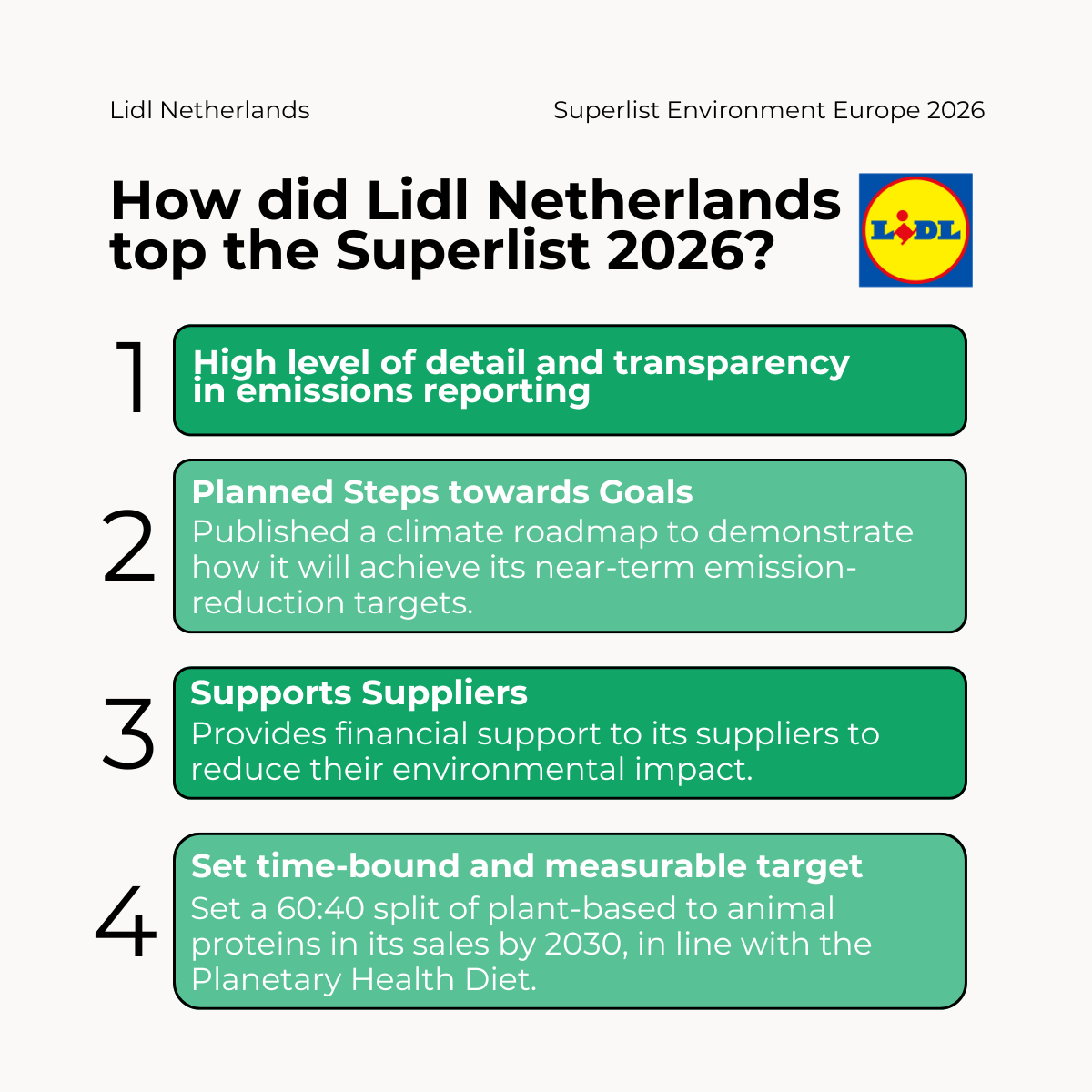
Many supermarkets have, in fact, seen total emissions rise in recent years. Given the lack of progress in this area, all supermarkets need to publish detailed roadmaps showing how they plan to reduce emissions in line with what is required by the Paris Agreement. So far, the Superlist reveals, only seven of Europe's top supermarkets have done this.
Rebalancing protein sales - a key climate measure
A crucial step all supermarkets can take to reduce emissions - which also has health and cost benefits - is to increase plants as a proportion of their protein sales. Dutch and German supermarkets have largely pioneered this approach to help reduce their scope 3 emissions (those from their entire value chain). Plant-based proteins such as beans and legumes create far fewer greenhouse gas emissions in their production than meat.
Leaders disclosed the protein balance in their sales and set targets to increase plant-based sales in line with the Planetary Health Diet. Yet, one in three European supermarkets, particularly in France, Poland, Spain, Sweden and the UK, has taken no action to rebalance protein sales, despite the crucial role it plays in achieving emissions reduction.
Leaders and laggards
The Superlist Environment Europe has revealed leaders and laggards across the continent when it comes to reducing emissions, something which for supermarkets is essential, given their outsized power over what food is produced and eaten in Europe and therefore their ability to shape a more planet-friendly food system.
Those supermarkets that take steps to rebalance their protein sales can reduce their emissions while offering their customers healthier, more affordable food and potentially cut costs.
Nico Muzi, Cofounder and Chief Programmes Officer at Madre Brava, said: “In Europe we eat too much protein and not enough fibre. That’s why doctors and nutritionists recommend eating more fruit, veg and legumes and less meat.
“Supermarkets can play a positive role in meeting this challenge by setting targets to rebalance protein sales to sell more plants. By looking after their customers’ health, they’re also looking after the planet and their own business interests, as more plants means lower emissions and lower costs.
“So far, the Dutch and German retailers are leading the way. We urge the British, Spanish and French retailers to catch up and ensure good, healthy food is affordable to all.”
Read the full Superlist Environment Europe 2026.
The Superlist Environment Europe is led by think tank Questionmark, in collaboration with partners WWF Netherlands, Madre Brava, and ProVeg International and with the support of ambassadors Changing Markets, Climate Action Network France, PAN DACH, RoślinnieJemy, Spanish Vegetarian Union and The Food Foundation.