1
September
2026
UK shoppers are shifting towards simpler, higher-fibre plant proteins, rather than dumping them, our analysis of new sales data for the first six months of this year has found.
The NielsenIQ data, which is featured in our analysis Britain backs beans: Health and affordability is driving growth of plant proteins, show beans, pulses, tofu and tempeh growing 7.3% (10.1% in value) versus the same period last year.
Plant-based meat alternatives do not fare so well, declining 4.3% in the number of units sold versus January to June 2025.
Overall, the data reveal that, in the first half of 2026, compared with the same period in 2025:
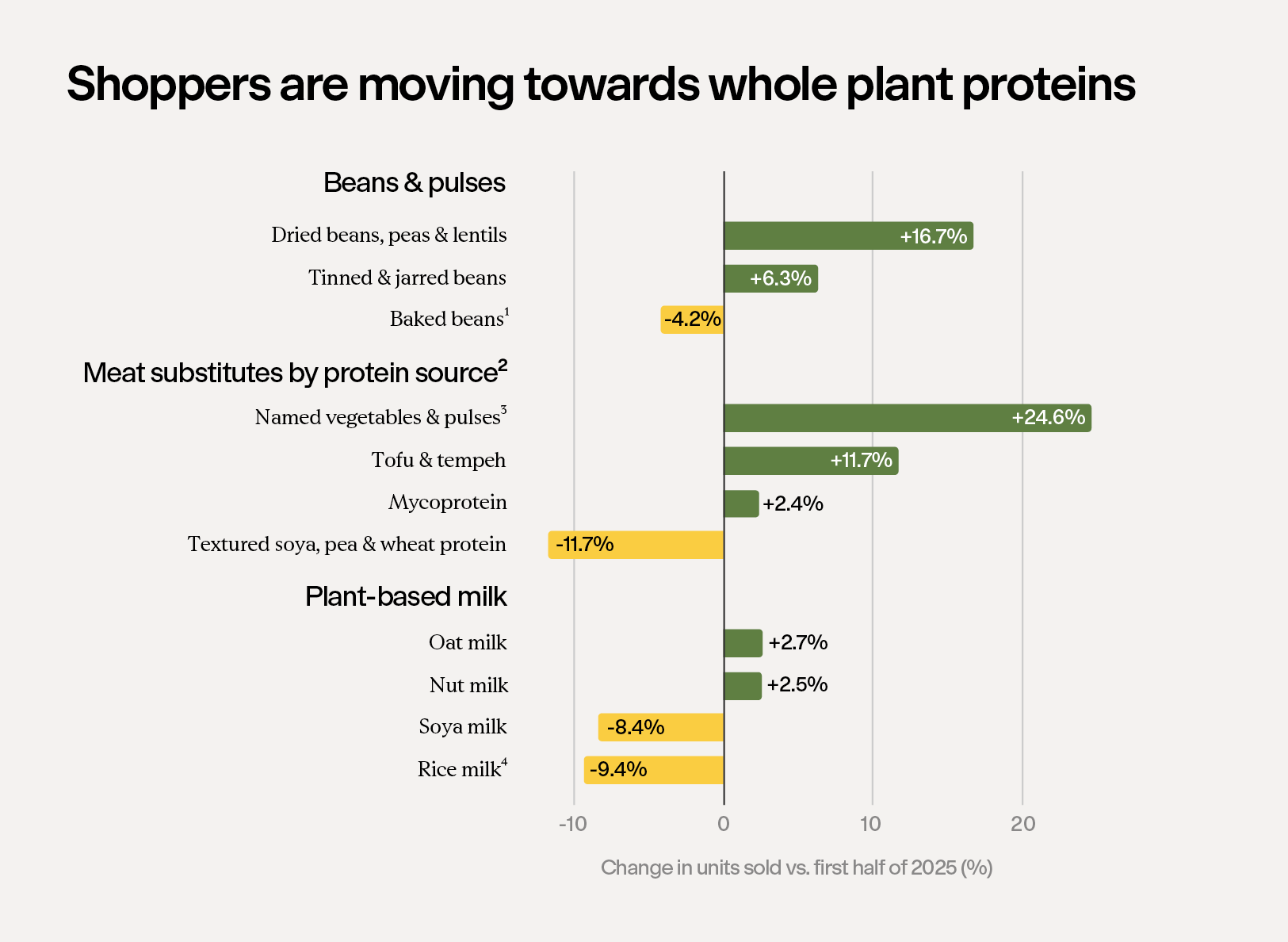
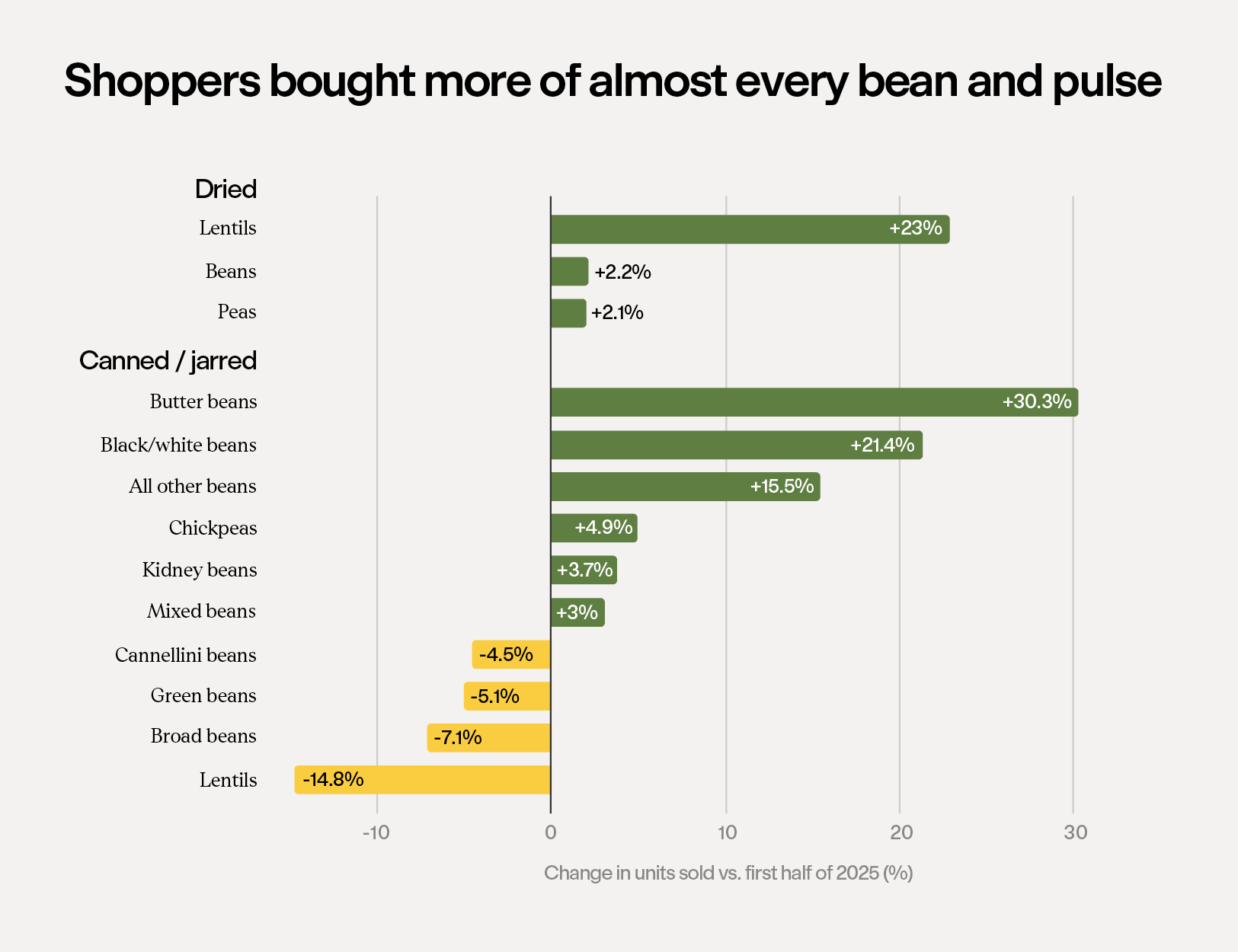
- Combined unit sales of beans, pulses, tofu and tempeh grew 7.3% (and 10.1% in value), dried beans, peas and lentils increased by 16.7%, canned and jarred beans by 6.4%, tofu by 7.2%, and tempeh by a huge 71.5%.
- Meat-free products made of vegetables and pulses, such as sausages and pies, including new products on the market, grew by 0.16 million units (24.6% on a small base of 0.64 million units).
- While plant-based alternatives designed to imitate meat declined 4.3% in units and 2.7% in value, mycoprotein (Quorn) bounced back, increasing by 2.4% (0.82 million units).
- Plant-based milk, which makes up 7% of the total milk market, grew slightly by 21,809 units (0.02%), with oat milk further dominating the category and growing by 1.55 million units (2.7%).
- Baked bean sales fell by 4.2% (in units) continuing a long-term decline in popularity, but a switch from single cans to multipacks means the drop is just 1.2% on a per can basis. The fall in baked beans is mainly in beans containing sausages. Sales of baked beans that did not contain processed meat were stable at 166 million cans sold.
Our UK Director, Sara Ayech said: “The bounce back in plant-based sales shows consumers are choosing foods that are a win for their health, their budgets and can compete on taste.
“Supermarkets account for more than 80% of our calorie intake. They can help drive this trend by ensuring a growing range of products that are the most convenient and appealing options for flexitarian customers, who want to eat more plants to fulfil nutrition goals.
“Setting targets for increasing the mix of plant proteins can also help retailers meet healthy sales and sustainability targets."
Health and affordability drive shopping decisions
The data suggest that, far from abandoning plant-based proteins, Brits are shifting their preferences in what plant-based products they are buying.
This could be down to health trends and affordability, with the combination of protein and fibremaxxing favouring plants and inflationary pressure pushing up meat prices.
The increases in sales of single-ingredient plant proteins that are seen as ‘natural’ or traditional, such as tofu, tempeh, seitan, beans and pulses, alongside reductions in alternative meat products, is an indicator of changing consumer behaviour in response to concerns about ultra-processed food (UPF).
Within the ‘meat mimic’ products, those that have minimally processed bases of tofu, pulses, or mixed vegetables saw increases, while products that have a base of textured wheat, pea or soy protein have seen a reduction, suggesting consumer attention to ingredients.
Some of the winners are companies like Gosh!, which makes falafels and bean-based sausages, and Quorn, which uses ‘mycoprotein’ and has, like several other companies, reformulated its products to address UPF concerns. Quorn may also benefit from its longstanding relationship with UK customers who trust its products.
Beans bounce
The premium sector for beans has seen growth driven by the Bold Bean Company. But that growth has not come in isolation, with more budget beans also seeing double digit growth.
Beth Latham, Head of Category + Strategic Projects at Bold Bean Co said:
"The Canned Pulses category is undergoing a real transformation. It was previously a dusty, highly commoditised aisle in the store that lacked innovation. However, over the last few years, the premium end of the category has reshaped how consumers think about beans, proving they are delicious and can be the hero of a meal."
Pushing plants
Commercial and civil society campaigns have driven interest in proteins that also contain fibre in the past year.
In October 2025, Lidl GB announced it had surpassed its 400% sales target to increase own label meat free and plant-based milk by 2025 (from a 2020 baseline), reaching 694%. In a bid to appeal to customers seeking to eat more plant-based foods, Lidl launched over 20 new own-brand products, including marinated tofu, falafel and tortellini.
Sainsbury’s also recently launched its ‘Full on Fibre’ labelling, which will highlight the fibre credentials of plant proteins like tempeh and beans, alongside fruit and veg, while M&S began a fibre campaign with Bowel Cancer UK, launching a new range of jarred beans.
The Food Foundation’s Bang in Some Beans initiative has seen celebrity chefs and brands extol the virtues of the humble legume.
Chloe Mackean, Food Business Transformation Manager at The Food Foundation, said:
“We aren’t surprised to see the rise in bean sales. Beans are a triple win for health, sustainability and our wallets. They are a healthy and affordable protein source, high in fibre and emit far fewer greenhouse gas emissions than animal protein.
“But beans are also tasty, and it is thanks to brands like Bold Bean Co, who pepper social media with photos of delicious bean recipes, that have helped to change people's perception.
"Large food companies are also aware of the commercial opportunities of beans and 29 companies, including Sainsbury's, Lidl GB, M&S, Bidfood, Brakes, Compass, Elior, The Compleat Food Group, Subway and Harvester, have all made commitments through our Bang In Some Beans campaign to sell more beans.”
The effect of retailer action
A group of organisations, including Madre Brava, The Food Foundation, WWF, ProVeg and Eating Better, recently called on retailers to set targets for increasing sales of plant proteins, relative to animal proteins, with an aim of reaching 30% plants as a proportion of the protein category by 2030.
Madre Brava has partnered with the World Resources Institute, WWF and ProVeg to call for the same across Europe.
The new data suggests retailers would be pushing at an open door with UK shoppers.
Read the full report.