.png)
16
April
2026
The price of meat in Spanish supermarkets continues to rise, with the gap between beef and legumes growing 48% in the last five years - our new analysis has found.
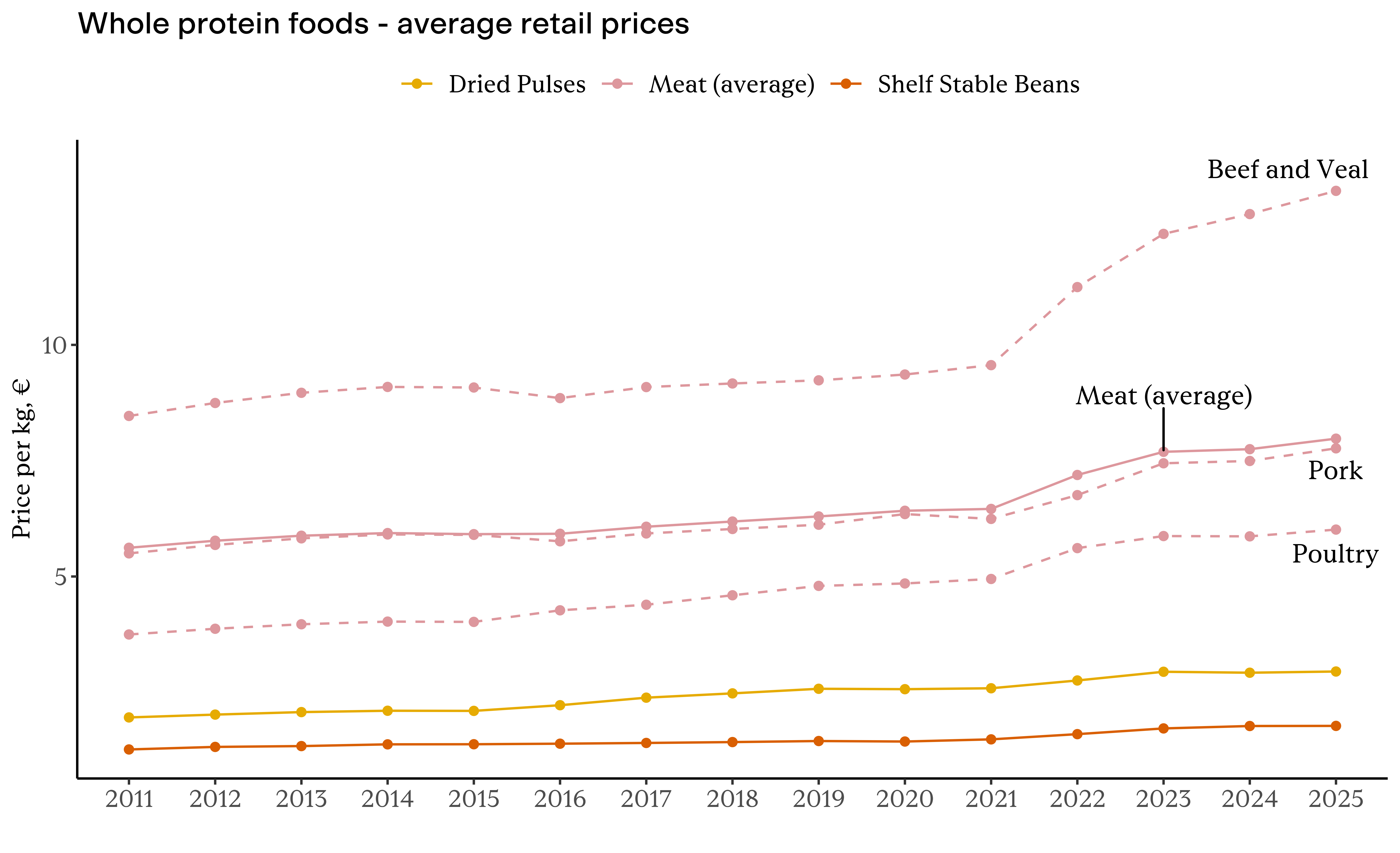
Using consumer price data from global market intelligence group Euromonitor, we tracked meat and plant protein prices for more than a decade.
In the past five years, the price gap between meat and plants has become even more pronounced and shows no sign of slowing, with the war in Iran putting renewed pressure on already high prices.
The data also show a marked decrease in the volume of meat sold by Spanish food retailers in recent years, suggesting that price conscious shoppers are reducing their meat consumption in response to rocketing prices.
The sustained increase in the price of meat - with rises of up to 25% in five years and more than 40% for beef - is piling pressure on households already struggling with rising energy and housing costs.
With many families at the limit of their food budget, supermarkets have an opportunity, as well as a responsibility, to promote affordable, healthy, and sustainable alternatives like legumes and other plant proteins, which could reduce the pressure on household budgets and help improve health at the same time.
Madre Brava is calling on Spanish supermarkets to commit to rebalancing their food sales to 60% plant-based and 40% animal-based by 2035.
There is also a huge opportunity for rural communities in growing more legumes in Spain, instead of importing them from North America.
Our Spain Director, Zinnia Quirós, said: “Inflation is not neutral. Low-income families already allocate one-fifth of their budget to food - as opposed to 12% for higher income households - and cannot afford to spend more. Producing and consuming more legumes in Spain is a solution that combines affordability, high nutritional value, and a lower environmental impact.”
Meat to legumes price gap will continue to widen
In the face of escalating meat prices, legumes maintain greater price stability, with the gap relative to meat widening every year. Meat prices have shot up, increasing by an average of €1.56 (€3.96 in the case of beef), rising from €6.42 in 2021 to €7.98.
Meanwhile, the cost of legumes has remained more stable. In the last five years, their price has risen €0.33 (going from €1.44 to €1.77) for canned legumes and €0.38 for dried legumes (from €2.57 to €2.96).
Temporary factors with long-term structural impact, such as international conflicts (Ukraine, Middle East), and structural factors like climate change - which make resources such as feed, fertilisers, water, and energy more expensive - will continue to drive up meat prices.
Healthy, affordable…
In addition to the budgetary benefits, legumes and plant proteins are a healthy option. They provide quality protein and, unlike many meats, contain less saturated fat.
Their fibre content, non-existent in meat, makes them a good combination for the prevention of cardiovascular diseases, type 2 diabetes, and various types of cancer.
Promoting plant proteins, especially legumes, is an effective lever to improve public health and ease pressure on the healthcare system. A healthier diet could save close to 20% of public healthcare spending according to some studies.
…and sustainable
Opting for diets richer in plant proteins is also one of the most effective ways to reduce emissions from the food system, with a climate potential up to five times greater than that of investments in renewable energy.
.png)
The pulses paradox
Despite the fact that the Spanish diet currently contains far fewer legumes than it should, the country’s fields only produce one-third of the legumes consumes.
Legumes still occupy too small a place in the Spanish diet and in Spanish fields. In 2024, their consumption was 3.36 kilos per person annually, barely 1.5% more than in 2023 and still very far from the recommended 11.5 kilos.
This slight uptick does nothing to reverse decades of decline and progressive distancing from the Mediterranean diet.
And it’s not just an economic challenge. In a country like Spain, where legumes are part of the gastronomic culture, people need help to include them more fully in their daily diet.
Supermarkets have the greatest capacity to accelerate this change, making it easier for people to find, buy and eat plant proteins.
“Leading this change cannot fall, once again, to consumers. We need supermarkets, as the architects of our shopping basket, to make it easy for us. They are the ones who have the power, and with it, the responsibility to make good food - healthy, sustainable, and tasty - the easiest and most affordable option,” Zinnia added.
What should supermarkets do?
Make it easy: ensure that healthy and sustainable options, such as legumes and other plant proteins, are the most affordable, visible, and accessible in-store, with competitive prices, good shelf placement, and presence in promotions.
Improve information on the shelf to guide choice: incorporate clear messages that connect food, health, and climate, helping consumers make quick, informed decisions aligned with their budget.
Lead the diversification of protein sources: invest in legumes and plant proteins, expanding the assortment, promoting private labels, and applying active pricing strategies to make them truly accessible.
Return to traditional foods: reinforce the commitment to legumes with more variety, formats adapted to current consumption (prepared meals, snacks, ready-to-eat options) that fit into daily life.
Set clear objectives to rebalance protein sales: aim for a split of 60% plant-based foods and 40% animal-based foods by 2035.
Read the full analysis: